
ALLIANCE COMMENTARY
U.S. Portugal sign an MOU to Establish a 12-month Pilot Program for 5 years
Assistant Secretary Marie Royce and Portuguese Ambassador to the United States Domingos Fezas Vital signed an MOU commemorating the launch of a 12-month pilot program between both nations.

Assistant Secretary Marie Royce and Portuguese Ambassador to the United States Domingos Fezas Vital signed an MOU on February 11.
The ceremony commemorated the launch of a 12-month pilot program that will run for five years, initially, between both nations with the intent to provide structured training for young American and Portuguese participants interested in learning about innovation, organizational growth and development. The Program was created based on collaboration among the Office of Private Sector Exchange (ECA), the U.S. Embassy in Portugal, and the Portuguese Ministry of Education.
The focus of the program will be on innovation – Portuguese interns/trainees will train at U.S. host organizations (for-profit and non-profit) that evidence innovation, are at an early stage in their development, or are pursuing advanced manufacturing.
Assistant Secretary Royce, following the signing, tweeted; “Today I was pleased to sign an entrepreneur-focused MOU, with Ambassador Domingos Fezaz Vital, between the U.S. and Portugal. Aimed at increasing global competitiveness, the program provides reciprocal benefits to U.S. and Portuguese participants. A win for both our countries.”
Exchange programs are a two-way street when it comes to commerce and industry.
As published on the American Foreign Service Association's website in January 2019.
By Marie Royce
Economic diplomacy works because of people. And the State Department’s Bureau of Educational and Cultural Affairs is in the people business. We are making the connections that are helping solve the business problems of today and tomorrow, both abroad and in the United States.
Take, for example, Ange Noelle Muco of Burundi and American Erica Hall, chief impact officer of the Akola Project, an international fashion design company with a flagship store in Dallas, Texas. On a recent State Department exchange for female entrepreneurs, the two women shared the story of how they connected their two supply chains at a critical time, benefiting both of their businesses. Ange and her fellow international businesswomen were in Dallas on an International Visitor Leadership Program, “Alumni as Economic Multipliers.” All of the participants had previously been on an exchange and were returning to the United States to make new connections. They met with U.S. companies in Dallas and several other U.S. cities, sharing best practices with American colleagues.
“I think we can be really self-focused if we don’t expose ourselves to things that are different, and ideas that are different, and people that are different,” says American Stephanie Giddens of Vickery Trading, which hires refugee women to assist with making their clothing line. “Until you get to know people, until they become your friends, and you do business with them, that makes all the difference in the world,” says American Valerie Freeman, CEO of the Imprimus Group, also of Dallas. Both Stephanie and Valerie took time from their schedules to meet with the international women.
Ange and the women in her group join thousands of State Department exchange participants who return home with new ideas after meeting with Americans across our great country. However, there is another story that is less often told—but as important—regarding how exchange programs also help American companies, like those of Erica, Stephanie and Valerie.
The U.S. National Security Strategy lays out four pillars, including the need to promote American prosperity. The strategy states that to succeed in this 21st-century geopolitical competition, America must lead in research, technology and innovation. And one way that American companies are achieving this goal is through connections made on exchange programs.
Take Mike Matesic from Idea Foundry in Pittsburgh, Pennsylvania, who participated in the State Department’s Young Leaders of the Americas Initiative reverse exchange program for Americans who host international YLAI participants. After completing his nine-day visit in Santiago, Chile, he told us: “We have identified several potential partners which we are following up with to discuss collaboration. This will support the transfer of innovations and talent between Santiago and Pittsburgh, in both directions.”
The economic benefit to Americans is also felt when participants come to the United States from other countries. On our Community Solutions program, Abdulsalam Mohammed of Ghana partnered with his host supervisor, Michelle Wilson from Global Ties in Akron, Ohio. Together they created the Accra-Akron Partnership Board, engaging the mayors of both cities to increase fair trade and collaborate to boost businesses in both cities.
One of the most powerful statements about exchange programs comes from Susan Cohig of the National Hockey League, who tells us that the espnW Global Sports Mentoring Program has helped her organization rethink their business challenges on a more global scale and take advantage of new opportunities. “It’s helped make us better as an organization,” she says. Her mentee Olga Dolinina returned to Ukraine to start “Break the Ice,” which works with kids from war-torn areas to provide the support and training they need to succeed and contribute to society.
Each year 40,000 State Department-sponsored participants and more than 300,000 private sector sponsored participants, who are overseen by the State Department on programs like Camp Counselor and Summer Work Travel, bring direct economic benefits to the American people, while contributing to our nation’s security. Well over 90 percent of ECA’s appropriation is spent in the United States or invested directly in American citizens or American organizations.
"Acquiring the skills to work in the global economy is enhanced through foreign language learning and exposure to foreign cultures and professional opportunities abroad."
We could not do the work we do without organizations like Global Ties, with their network of 100 organizations serving all 50 states. Mostly comprised of volunteers, these citizen diplomats make connections in their communities with businesses and organizations, then connect them to international participants. And I am proud that ECA is expanding our pool of U.S. private sector partners. These partners range from professionals who share their specialized skills with foreign exchange participants, to schools and universities hosting educational exchanges and businesses that host foreign professionals who, in the process, contribute to Americans’ international expertise and networks.
We expand economic prosperity by increasing the capability of Americans to operate internationally and furthering the reach of U.S. businesses and institutions. Acquiring the skills to work in the global economy is enhanced through foreign language learning and exposure to foreign cultures and professional opportunities abroad.
Thousands of businesses across this country tell us they are stronger because of exchange participants. Seasonal businesses in destinations like Ocean City, Maryland, and Santa Cruz, California, tell us that they would not be open without exchange participants on Summer Work Travel, who can work in late spring or early fall when American students are in school.
These participants bring new perspectives to American businesses, while also allowing these businesses to stay open longer, after American students return to school.To increase global competitiveness, ECA helps to internationalize workplaces and U.S. campuses, supporting professionals and foreign students who study and work alongside Americans. State Department exchange programs are making a real difference in our economy and in our global economic and trade relationships—one exchange participant at a time.
Marie Royce was sworn in as assistant secretary of State for educational and cultural affairs in March 2018, following unanimous Senate confirmation. She is a businesswoman and former professor.
Ilir Zherka
As published on the StudyTravel Magazine of EnglishUSA on December 5, 2018.
This week, we interview Ilir Zherka of the Alliance for International Exchange about the group's activities, useful resources for agents, and how it marked its 25th anniversary.
Firstly, can you tell us a little about the Alliance for International Exchange?
The Alliance for International Exchange serves as the only collective public policy voice of the exchange community, by promoting the growth and impact of exchange programs and the effectiveness of its members, by engaging in advocacy, providing member development opportunities, and by building public awareness of the power of exchange.
What has the Alliance been up to in the last year?
In the last year, the Alliance has done a lot in terms of advocacy, research, and communications.
The Alliance introduced its first-ever Exchange Week in the District, which enables our members and other stakeholders to reinforce the impact of exchange programs at the state and district levels.
We engaged in a wide-range of policy issues by: sharing our views regarding negative changes to the definition of “unlawful presence;” submitting a comment letter on an increase in SEVP fees; engaging with ECA and Consular Affairs on visa denials; opposing restrictions on recruiting and program fees in Romania; and submitting an Amicus Brief to the First Circuit Court in support of the Au Pair program.
We also commissioned and released a major, comprehensive report on the Intern and Trainee programs by EurekaFacts.
We reported last year about reported proposed cuts to exchange programs and the feared impact of these. Have those fears subsided? Was is the current state of play?
Since the proposed cuts were reported last year, we facilitated bipartisan congressional support for privately-funded exchange programs. While the threat seems to have receded thus far, we are aware that there is attention being paid by some to these programs with an eye toward greater restrictions and cuts. We are, therefore, continuing our intensified educational and advocacy efforts, and we suggest others do the same.
What are the benefits to international students and to the US itself of exchange programs?
International students benefit the US in several different ways or areas. They support the U.S. national security because more than 200 countries and territories visit the U.S. from countries critical to U.S. foreign policy. International students also strengthen the U.S. economy. In fact, in the 2017-2018 academic year, international students contributed $39 billion to the U.S. economy and supported over 455,000 jobs.
Our readership is predominantly comprised of agents and students recruitment companies, and of course, many of these are promoting J-1 programmes. Do you have any engagement with agents around the world, or any resources that might be useful for agencies?
We have several resources that might be useful for agencies on the “Impact and Resources” page of our website. On this page, we have gathered all the information on the benefits of exchange programs: such as, our Exchanges impact one-pager; state fact sheets with information by state; our Intern/Trainee and Summer Work Travel reports; and the latest numbers from Department of State. They might also benefit from reviewing our Advocacy page, which includes suggestions for engaging elected officials that should apply to their countries, too.
In terms of wider international student recruitment, the last couple of years have been challenging for educators in the US, particularly IEPs. Has that trend impacted on the exchange sector at all?
According to the Open Doors Report, new student enrollments fell by 6.6 per cent in 2017. This trend, however, started in 2015. That decline is certainly having an impact.
I gather you have recently market your 25th anniversary. How did you celebrate this?
Our 25th Anniversary Gala dinner hosted 256 attendees, including 105 Alliance members and supporters, 11 government officials, and five previous Alliance staff. It was truly an evening to remember.
What does the Alliance have planned for coming months?
There is a continuing need to educate policy makers and the general American public about the power of exchange programs to increase greater mutual understanding between peoples. We’ll be doing that through an upcoming report on the Camp Counselor program, visits to congressional offices in Washington, DC and locally, as well as other programs. People abroad can figure out how to get involved by subscribing to our Weekly Digest through our website.
Ilir Zherka is the Executive Director of the Alliance for International Exchange.
Open Doors Report Shows 1.5 percent Increase in International Students Coming to the U.S.
The 2018 Open Doors Report shows a 1.5% increase in the number of international students coming to the U.S for higher education: 1,094,792 international students enrolled in United States higher education institutions in 2017/18 compared to 1,078,822 students in 2016/17.

The 2018 Open Doors Report shows a 1.5% increase in the number of international students coming to the U.S for higher education: 1,094,792 international students enrolled in United States higher education institutions in 2017/18 compared to 1,078,822 students in 2016/17.
The Open Doors report further shows that international students continue to have a significant positive impact on the U.S. economy. According to the Department of Commerce, these students contributed more than $42.4 billion to the U.S. economy in 2017, in contrast to $39 billion in 2016.
“International students studying alongside Americans are a tremendous asset to the United States,” said Marie Royce, Assistant Secretary of State for Educational and Cultural Affairs. “We need to develop leaders in all fields who can take on our toughest challenges. We need people who can find solutions that keep us secure and make us more prosperous. We want to send a message that international education makes us stronger as a country,” the report reads.
Learn more about the report here.
New NAFSA Economic Impact Analysis: International students contribute $39 Billion to the U.S Economy
New data recently released by NAFSA: Association of International Educators indicate that the more than one million international students studying at U.S. colleges and universities during the 2017-18 academic year contributed $39 billion to the U.S. economy, while at the same time supporting more than 450,622 jobs. These numbers represent a 1.2% increase in job support and creation and a 5.8% increase in dollars contributed to the economy compared to the previous academic year.

New data recently released by NAFSA: Association of International Educators indicate that the more than one million international students studying at U.S. colleges and universities during the 2017-18 academic year contributed $39 billion to the U.S. economy, while at the same time supporting more than 450,622 jobs. These numbers represent a 1.2% increase in job support and creation and a 5.8% increase in dollars contributed to the economy compared to the previous academic year.
NAFSA’s full report shows the benefits of international students in the United States, including enrollment data, economic contributions, and jobs supported. Particularly for jobs supported, the report finds that for every seven international students enrolled, three U.S. jobs are created.
Esther D. Brimmer, NAFSA Executive Director and CEO, stated the following about the new data:
“The data continue to demonstrate that international students and scholars are a tremendous asset to our nation, contributing billions of dollars to our economy, thus generating hundreds of thousands of jobs in our local communities. And this is in addition to the immeasurable academic, security and cultural value these students bring. International students and scholars create jobs, drive innovation and serve as America’s best ambassadors and allies."
NAFSA conducts an annual state-by-state and congressional district analysis of the economic contributions of international students and their families to the U.S. economy. This year, once again 10 states, including California, New York, Massachusetts, Texas and Pennsylvania, broke the $1 billion mark in contributions from international students. These states received a large contribution to their economy from spending by international students on living expenses, tuition and fees. The analysis also shows that with every seven enrolled international students, three U.S. jobs are created by spending in higher education, accommodation, dining, retail, transportation, telecommunications and health insurance.
State- and district-specific information can be accessed here.
Speaking up for International Exchange Programs

As published on the Global Ties U.S. website on October 29, 2018.
By Sue Yang, Senior Director for External Relations, Alliance for International Exchange
Advocacy is at the nexus of policy, people, and exchanges. If you've ever wondered how policymakers decide on issues in Washington, DC, or how organizations can best engage in advocacy, here are three tips to get started.
To engage in advocacy, organizations should:
Be a voice for international exchange programs.
A vital part of how elected officials decide on issues is understanding how they affect their constituents, district, and state. The more policymakers understand the issues, the better informed they can be in making policy decisions.
While it may seem like there are plenty of voices already out there advocating on behalf of your issues, every voice counts. The more voices there are in support of these important exchange programs, the stronger the message and its impact. So make your voice heard.
For the international exchange community, there are many policy and budgetary challenges. In recent years, the Administration budget requests for U.S. Department of State's educational and cultural exchange programs have been decreasing – most recently, the Fiscal Year 2019 budget request was more than a 75% reduction from the Fiscal Year 2018 enacted level.
Thankfully, due to strong bipartisan Congressional support, funding for international exchange programs has been robust in recent years. An important factor for that strong support is the advocacy efforts by the Alliance for International Exchange and members of the international exchange community.
Be a resource.
Educate and inform your elected officials on exchange program issues. Be informative, concise, and clear. For example, avoid acronyms and other industry jargon without explaining what they mean. Discuss only what you know – you can always follow up with more information. This is important, as you want to be viewed as a credible and informed voice. If you are a knowledgeable resource for how international exchange issues affect the district and state, then your message will have a stronger impact.
Build a relationship.
Reach out to the offices of your Members of Congress, as well as other elected public officials at the state and local levels. Contact their district and state offices to request meetings with staff to discuss your cause. Get to know the staff as they advise the elected officials. Reach out to state and local officials as well. Engage with those who directly represent you – elected officials prioritize hearing from their constituents.
Work with other community leaders (such as business leaders, local associations, or civic activists) to strengthen and broaden the network supporting international exchange programs. These meetings are opportunities to build and sustain a professional relationship with policymakers and policy influencers. As with all relationships, it takes time to build one so be proactive and have a long-term perspective.
As you engage in advocacy efforts, maintaining a unified message on international exchange programs is essential to reinforcing their key role in our public diplomacy efforts. Specifically:
Exchange programs support our national security and foreign policy interests.
Exchange programs strengthen the U.S. economy.
Exchange programs increase mutual understanding.
Introducing the 2018 Mccarry leadership awardees!
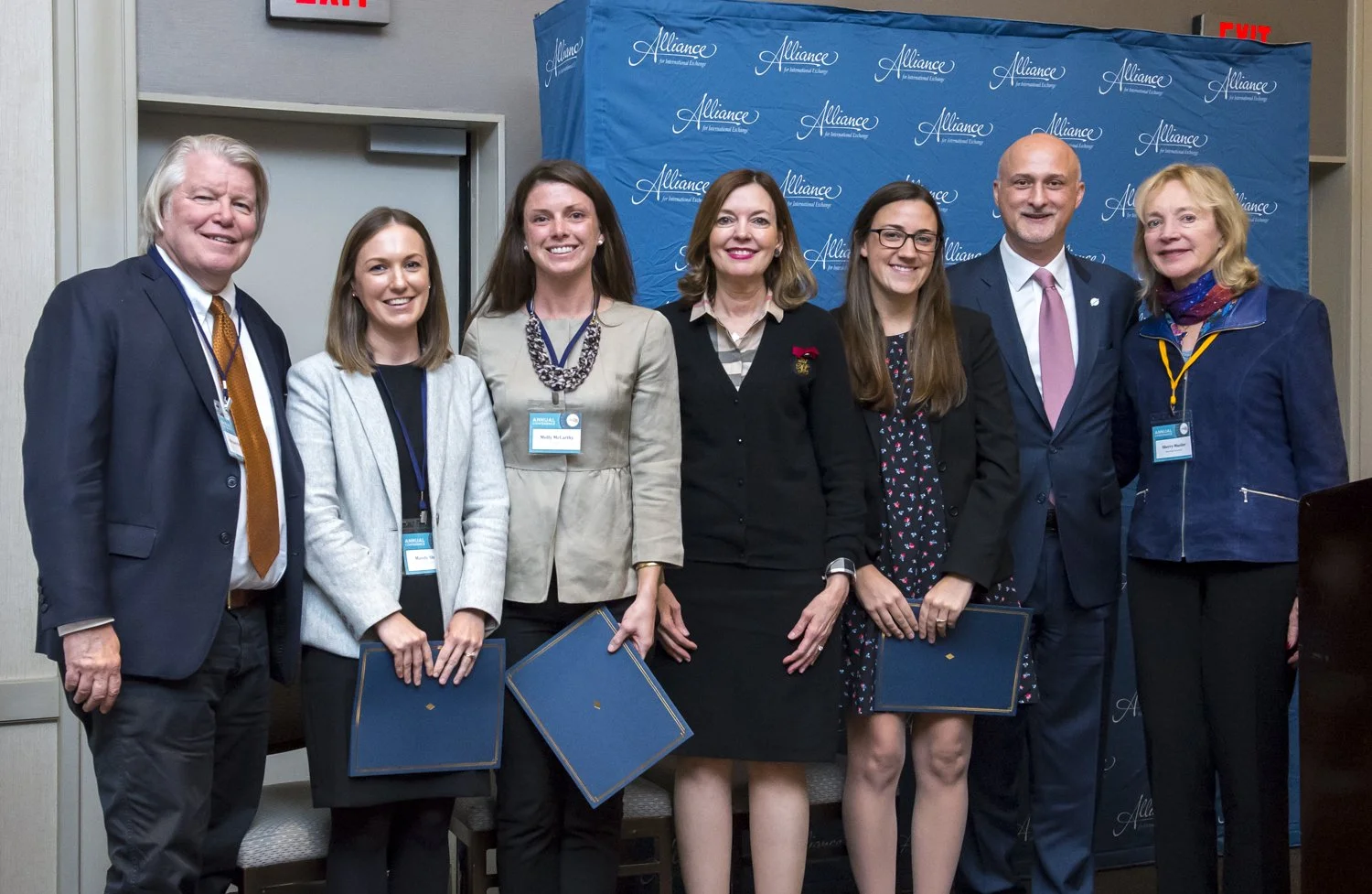
Mallory carpentier, senior regional coordinator, geovisions
Molly mccarthy, employment relations manager, ciee
mandy sheriff, alumni relations manager, afs-usa
Response to “Shortchanged” Report Regarding the Au Pair Cultural Exchange Program
The International Labor Recruitment Working Group (“ILR”) recently issued a report entitled, “Shortchanged: The Big Business Behind the Low Wage J-1 Au Pair Program” (the “Report”). The Report is replete with unfounded allegations and inaccuracies. It ignores the positive feedback the vast majority of au pairs provide regarding their experience, while attempting to discredit the important cultural exchange benefits the program provides. Among other things:
Based upon interviews of only 16 current and former au pairs, out of a pool of approximately 150,000 just in the last ten years of this thirty-year old program, the Report claims that au pairs are unhappy with the program. According to a recent State Department presentation, 88% of au pairs reported in exit surveys that they were satisfied with the Au Pair Program, while only 4% report that they were dissatisfied. (The balance did not answer.) Many au pairs even extend their participation, voluntarily, beyond their first year.
The Report fails to recognize important oversight provided by the United States Department of State. For example, the Report ignores the fact that sponsors submit detailed, annual reports prepared by independent auditors that help ensure sponsors’ compliance with applicable regulations.
The Report wrongly suggests that au pairs have no recourse if a host family wants them to perform more work than is permitted. In fact, each au pair is assigned a local representative who, by regulatory requirement, must reside near the au pair and must make monthly personal contact. Au pairs have other resources as well including the entire full time staff of each program sponsor. Additional support includes the State Department’s toll-free “J-1 Visa Emergency Helpline” telephone number, which is available 24 hours a day, 7 days a week as well an au pair-specific email to report any concerns. On the Exchange Visitor section of the State Department’s own website, they provide the contact information for the National Human Trafficking Resource Center and the Trafficking in Persons and Worker Exploitation Task Force.
The Report repeats the disputed assertion that Sponsors have somehow improperly limited au pair stipends paid by host families to $4.35 per hour. At most, the sponsors passed along the minimum stipend amount calculated by the State Department and issued publicly in State Department notices, which is an amount that families are free to exceed. Moreover, the Report fails to acknowledge the many other benefits – monetary and otherwise -- that these young cultural exchange visitors experience when they are invited to enjoy American life and culture and are welcomed as members of the family into the homes and lives of their hosts.
Over more than three decades, the Au Pair Program has allowed hundreds of thousands of young persons from around the world to come to the United States, live with a family, improve their English language skills, and be immersed in American culture. Even if a limited number of host families and au pairs do not follow the rules, the sponsors and the State Department work diligently to find those violations and address them. Any violation of the program regulations is unacceptable and must be addressed appropriately. However, the allegations described in these limited cases were made anonymously and sponsors have not been given the opportunity to be made aware of who they are so that they can be properly addressed. The Report ignores the support resources that are available to au pairs, the commitment to addressing concerns by the program sponsors as well as the transformative cultural exchange benefits of the program, and offers a jaundiced presentation that is neither objective or accurate.
EurekaFacts Camp Counselor Report
We are thrilled to announce the release of the EurekaFacts Camp Counselor Report.The report found that the Camp Counselor program positively impacts the United States by strengthening our national security and supporting our economy. Not only did 76% of participants develop a more positive view of American people, they also contributed over $59 million dollars to the U.S. economy during their stay.

We are thrilled to announce the release of the EurekaFacts Camp Counselor Report.
The report found that the Camp Counselor program positively impacts the United States by strengthening our national security and supporting our economy. Not only did 76% of participants develop a more positive view of American people, they also contributed over $59 million dollars to the U.S. economy during their stay.
You can access the full report here.
Professional Exchanges Support U.S. Public Diplomacy Goals
Young professionals around the world are striving to compete in today’s global economy. As individuals have become more interconnected with their counterparts across the world, international training has also become a highly valued skill. American policymakers are actively working to leverage a desire for training as a way to establish stronger business, political, and social ties with countries around the world. The tool? Intern and Trainee programs. Designated by the U.S. Department of State, these programs serve these key goals while also affording international professionals valuable skills, expertise, and cultural insights.
Over 35,000 international Intern and Trainee participants came to the United States in 2017. While Interns are current university students or recent graduates, Trainees are individuals with five or more years of experience or recent graduates with a year or more of experience. Both of these programs afford international participants the opportunity to temporarily live in the United States while taking part in professional training with host organizations and companies.
While Intern and Trainee participants strive to acquire necessary skills, the United States gains a unique opportunity to advance its public diplomacy goals. A recent study by EurekaFacts, Intern and Trainee Exchange Program 2018 Review Report, found that the U.S. is exporting its image, values, and best practices with each participant’s return home. A staggering 95% of participants have a positive experience in the U.S. during their stay, 75% develop a more positive opinion of Americans, and 73% develop a more positive opinion of the U.S. in general. Comparable programs also benefit American workers. 71% of host organizations offer equivalent Intern or Trainee program opportunities for Americans.
The United States also gains economically. The study found that in 2017 alone, Interns and Trainees contributed over $662 million during their average eight-month stay. Individually, program participants have a significant economic impact on American local communities, contributing approximately $2,000 each month on expenses like housing, food, entertainment, and travel.
Host organizations, comprised of a range of American-based companies, benefit as well. In fact, EurekaFacts found that 85% of hosts surveyed said the Intern and Trainee programs are important to their business. One reason is that they allow current staff to broaden their perspectives through exposure to different cultures. 75% of host organizations agreed that this phenomenon regularly occurs in the workplace. Additionally, 60% of host organizations said they would experience a negative impact without the programs.
Professionally-based exchanges are increasingly integral to companies as the new relationships formed through these programs lead to overseas partnerships. The study affirms these partnerships will continue to multiply: 70% of participants report a more positive opinion about the American way of doing business and about American companies in general.
Intern and Trainee programs illustrate a clear “win-win” for both the United States and participants. As valuable public diplomacy tools supporting U.S. national security, these programs simultaneously help American businesses and strengthen our economy.
Ilir Zherka is Executive Director of the Alliance for International Exchange.
Laine Cavanaugh, Alliance Senior Manager, contributed to this article.
SWT: Just the Facts on Cultural Exchange

Ilir Zherka, Contributor
Executive Director of the Alliance for International Exchange
Just the Facts on Cultural Exchange
09/14/2017 08:32 am ET Updated Sep 14, 2017
A recent study by Pew found that the United State’s favorability rating globally hovers below 50 percent, with a sharp distrust of this administration among some of our closest allies in Europe and Asia. As we consider the implications these findings might have on policies ranging from defense to disaster relief to trade and investment, we are puzzled why the White House would be considering major changes to or the complete elimination of a proven cultural visitor exchange program that costs the taxpayer nothing.
Started by the State Department in 1961, the J1 Exchange Visitor Program— which includes Summer Work Travel, Camp Counselor, Intern and Trainee and Au Pair programs—has brought students and others from overseas to the U.S. to learn English, study, and gain exposure to American culture. One of the ways in which this is done is through temporary, seasonal work—largely in the tourism and hospitality industries during peak travel seasons where exposure to the language and culture in a real-life setting enhances the student’s experience and sends them back to their home countries with some new skills and, importantly, perspectives.
Despite the incredible diplomatic benefits of the Exchange Visitor Program, a small group in the White House has deemed it a threat to the American workforce. As a result, they have linked it to the broader Buy American, Hire American (BAHA) Executive Order efforts currently underway. These efforts look to cut back on immigration programs that some see as undercutting American jobs. But the Exchange Visitor Program is not an immigration program or a jobs program—it’s a cultural exchange program. Young people come here for short periods of time, typically four months or less, to experience American life first-hand and then return to their home countries. As the international government and business leaders of tomorrow, putting it in the BAHA cross hairs is simply misguided and short-sighted.
A recent study conducted by Eureka Facts shows why. Led by Public Affairs Research Director Alec Ulasevich, PhD, Malinda Rhone, PhD, and Principal Jorge Restrepo, the study found that the Summer Work Travel (SWT) program, one of the five programs being targeted as part of BAHA, delivers significant benefits in terms of public diplomacy and the U.S. economy. Critically, it shows that SWT students help U.S. businesses meet their seasonal labor shortages in areas and times when American workers are not available, particularly in the “shoulder seasons” of early spring and late fall when young Americans are typically in school. The analysis also found that SWT participants do not – as some in the administration argue – displace local workers. In fact, one quarter of surveyed employers indicated that without the presence of SWT students to complement their American workforce, they would not be able to operate at capacity during their peak season. Employers recruitment through advertisements, at job fairs, visits to college campuses, social media, and other methods. But these efforts often are not enough. Some employers report that they could be forced to lay off full-time staff or even close their doors without the seasonal SWT supplement.
The study also finds the SWT program helps to keep local, seasonal economies strong. Last year, participants in the program contributed more than $500 million to the U.S. economy via money they spent during their shorts stays in the country. Exchange visitors, furthermore, earn the exact same wage as their counterparts. Costs to employers can actually be greater for these employees due to program, travel and other expenditures required by the State Department.To suggest that the SWT in any way threatens the American worker and economy, according to this study, is simply inaccurate. Couple that with proven diplomatic benefits, and this is a program that should be held up as a model, not one targeted for elimination. For example, 91 percent of the SWT participants surveyed chose to take part in the program because of the cultural exchange opportunity, rather than to make money or learn work skills. 76 percent return to their home countries with a higher overall regard for the U.S., and three in four say their opinions of American people became more positive after their time here. In the spirit of the original legislation that established these Exchange Visitor programs, the Mutual Educational and Cultural Exchange Act of 1961, participants leave the program with greater understanding of the United States while making lasting friendships with Americans they met.
Many in Congress also strongly disagree with the inclusion of Exchange Visitors in BAHA. In fact, Members of Congress from both the U.S. Senate and the House of Representatives urged Secretary Tillerson to oppose such an action. Governors and business owners across the country have also weighed in with their opposition.
The tradition of cultural exchange is part of the fabric of our democracy. It has played an important role in the broader global diplomatic efforts of the U.S. for more than 50 years. So just the facts, please. These young people are not threats to the American worker or the economy. They are the world’s future employers, diplomats, leaders, and innovators whose short time in our country contributes to greater global camaraderie, understanding, and respect.
Link to article on Huffington Post.
This is a test National News Article
Test Test Test Test Test Test Test Test Test Test Test Test Test Test Test Test Test Test Test Test Test Test Test Test Test Test Test Test Test Test Test Test Test Test Test Test Test Test Test Test Test Test Test Test Test Test Test Test Test Test
Test Test Test Test Test Test Test Test Test Test Test Test Test Test Test Test Test Test Test Test Test Test Test Test Test Test Test Test Test Test Test Test Test Test Test Test Test Test Test Test Test Test Test Test Test Test Test Test Test Test Test Test Test Test Test Test Test Test Test Test Test Test Test Test Test Test Test Test Test Test Test Test Test Test Test Test Test Test Test Test Test Test Test Test Test Test Test Test Test Test Test Test Test Test Test Test Test Test Test Test Test Test Test Test Test Test Test Test Test Test Test Test Test Test Test Test Test Test Test Test Test Test Test Test Test Test Test Test Test Test Test Test Test Test Test Test Test Test Test Test Test Test Test Test Test Test Test Test Test Test Test Test Test Test Test Test Test Test Test Test Test Test Test Test Test Test Test Test Test Test Test Test Test Test Test Test Test Test Test Test Test Test Test Test Test Test Test Test Test Test Test Test Test Test Test Test Test Test Test Test Test Test Test Test Test Test Test Test Test Test Test Test Test Test Test Test Test Test Test Test Test Test Test Test Test Test Test Test Test Test Test Test Test Test Test Test Test Test Test Test Test Test Test Test Test Test Test Test Test Test
Administration’s FY 2019 ECA Budget Would Hurt U.S. Diplomacy
The Fiscal Year (FY) 2019 budget released today by the Administration proposes a steep 75 percent cut to the U.S. Department of State’s Bureau of Educational and Cultural Affairs (ECA). Specifically, the FY19 request of $159 million is a significant reduction from ECA’s actual budget of $634.1 million in FY17. Last year, the Administration recommended a 55 percent cut to ECA. Although a long-term FY18 budget has not been finalized, Congress recognized the importance of ECA and increased its funding for FY17.
Washington, DC (February 12, 2018) – The Fiscal Year (FY) 2019 budget released today by the Administration proposes a steep 75 percent cut to the U.S. Department of State’s Bureau of Educational and Cultural Affairs (ECA). Specifically, the FY19 request of $159 million is a significant reduction from ECA’s actual budget of $634.1 million in FY17. Last year, the Administration recommended a 55 percent cut to ECA. Although a long-term FY18 budget has not been finalized, Congress recognized the importance of ECA and increased its funding for FY17.
“The proposed cuts to ECA’s budget recommended by the Administration, if enacted, would greatly harm our nation’s public diplomacy efforts and, ultimately, our national security and economy,” said Ilir Zherka, Executive Director of the Alliance for International Exchange.
Educational and cultural exchange programs have been a critical component of our national security policy since the end of World War II. Often described as part of our “soft power” strategy, these programs bring people from around the world to the United States for short-term, full immersion stays that range from weeks to an entire academic year. The State Department reports that 1 in 3 current world leaders have been on an exchange program in the United States. In another Department study, 92 percent of participants from Muslim majority countries reported having a more favorable view of the United States. Over 90 percent of ECA’s budget is spent in the United States or by Americans administering grants which fund travel, lodging, and meals at U.S. businesses. The grants are administered by American nonprofit organizations that employee thousands of people in the United States and enrich the lives of millions across the country.
“Congress has consistently demonstrated a strong, bipartisan commitment to exchange programs,” said Ilir Zherka, Executive Director. “We call on Congress to recommit our country to people-to-people diplomacy by providing strong funding for ECA.”
As the voice of international exchange, the Alliance promotes the growth and impact of exchange programs and the effectiveness of its members by engaging in advocacy, providing member development opportunities, and building public awareness of the power of exchange
###
Alliance Congratulates Marie Royce on Nomination to serve as Assistant Secretary for ECA at the Department of State
“The Alliance for International Exchange congratulates Ms. Marie Royce on the announcement of President Donald J. Trump’s intent to nominate her to be Assistant Secretary of State for Educational and Cultural Affairs.
Washington, DC – Ilir Zherka, Executive Director of the Alliance for International Exchange, issued the following statement regarding the nomination of Marie Royce to serve as Assistant Secretary for the Bureau of Educational and Cultural Exchange (ECA):
“The Alliance for International Exchange congratulates Ms. Marie Royce on the announcement of President Donald J. Trump’s intent to nominate her to be Assistant Secretary of State for Educational and Cultural Affairs."
“This is a central role in furthering people-to-people diplomacy. The exchange programs the Department funds and oversees strengthen our economy and support our national security by increasing mutual understanding between Americans and people around the world."
“Ms. Royce brings a strong understanding of international exchange programs. She has served on the Advisory Committee on International Communications and Information Policy at the Department of State, on the Board of Trustees of Meridian International Center, and as a former educator and university professor. We look forward to her confirmation process and to continuing our work with the Department of State in supporting U.S. foreign policy interests.”
###
The Alliance for International Exchange is an association dedicated to promoting the growth and impact of exchange programs. Since 1993, it serves as the collective public policy voice for now over 90 nongovernmental organizations comprising the international educational and cultural exchange community in the United States. The Alliance increases awareness of the impact of people-to-people diplomacy.
Introducing the 2017 McCarry Leadership Awardees!
2017 McCarry Leaderhip Award recipients.

Leslie Corn, Senior Director, Cultural Exchange Network Corporation (CENET)What began as an Office Assistant job out of college turned into a challenging, zigzagging journey of 7 years. Working with people from around the globe, understanding cultural differences, and striving for a kinder, more humane world, has become Ms. Corn’s drive as she works, travels, and develops her acumen in this ever-important field. Hers has not been an Ivy League tract, but a Midwestern plodding, a learning and re-learning by doing, by failing, by learning some more, by overcoming, and, finally, by developing a deep driving empathy for those who are embarking on a journey. This empathy led her to create Culture in the Community, a program focused primarily on underfunded schools, with a mission to teach students the beauty of differences. After wearing many hats at CENET, Ms. Corn became Senior Director. What years of dedication in the exchange community has taught Ms. Corn is the wonderful truth that there is always much more to learn.
"The Annual Meeting is a great opportunity to learn and connect within the exchange community. Despite being competitors, it’s understood that we’re much stronger together than we are as individual organizations. J. William Fulbright once said that exchanges "can turn nations into people, contributing as no other form of communication can to the humanizing of international relations." It was a privilege to gather in D.C. and to endeavor as a community to do just that-- humanize international relations and advocate for programs that inspire a better world."
Leslie Costa, CEO & Founder, The International Student CompanyFor the last six years, Leslie Costa has been the custodian for connecting students, graduates and young professionals, seeking to enrich their own career prospects, with valuable work experience opportunities throughout the United States. As a true cross cultural advocate and a recognized leadership expert, Ms. Costa can be found speaking about the benefits of getting out of comfort zone by engaging in cultural exchange experience at, corporate events, webinars at local and international universities. With the support of U.S. Department of State, Ms. Costa has recently founded the first international exchanges conference in the U.S.: International Exchange Summit (I.E. Summit) that connects awesome J-1 participants from all across the globe with local and international leaders across industries based in Florida. Ms. Costa holds a Master’s Degree in Corporate Finance from Group INSEEC in Paris, France.
"After receiving this award, I feel even more energized and motivated to advocate and fully embrace the responsibility of ensuring that we continue to foster mutual understanding between nations.I left the Annual Meeting with the confidence that what we do is important and highly beneficial for the world, I am positive that we will overcome the current challenges on the J-1 Exchange Visitor Programs, with the right determination and resilience.”
Janice Fox, Northeast Regional Account Manager, Intrax Work TravelJanice Fox is the Northeast Regional Account Manager for Intrax Work Travel, based near Cape Cod, Massachusetts. Growing up in a military family, Ms. Fox became accustomed to travel and cultural exchange at an early age, which later became two of her passions. Ms. Fox had her first cultural exchange experience when she studied abroad in Rabat, Morocco. After obtaining her Bachelor’s degree in French, she spent a year teaching at English First in Changchun, China and, later, returned to Morocco as an English and Foreign Language Teacher at Amideast in Casablanca. The care and compassion her host communities demonstrated during her time overseas led Ms. Fox to pursue a career in the field of cultural exchange and inspired her to focus on enhancing the experiences of exchange visitors in the United States. In her current capacity, as a regional account manager at Intrax, Ms. Fox identifies ideal host employers and communities, and collaborates with local organizations to improve transportation and safety resources available to Summer Work Travel participants. Prior to her current position, she worked as an operations assistant and field support coordinator.
"Attending the annual meeting provided focus on long and short-term goals for myself and for the larger cultural exchange community. The panels and workshops offered excellent insight into the work we’ve already accomplished together and where we can go next. We all realize it won’t quite be “business as usual” for the next couple of years, and I gained valuable tools to apply to both advocacy and day-to-day operations work that will be critical in ensuring the future of our exchange programs. After listening to and speaking with many experienced and passionate colleagues, I left the meeting feeling reassured about our strength as an industry and community."
Lisa George, Manager of Latin American Youth Programs, World LearningLisa George is a youth development professional, with ten years of experience in international exchange programs and training. She is an AFS-USA Returnee (Costa Rica) and longtime AFS-USA volunteer. She is a previous member of the AFS-USA National Council (2012-15; 2016-17) where she acted from a national perspective to make decisions for the good of the organization, while representing volunteer needs, views and opinions to the AFS-USA executive management team and the Board of Directors. Ms. George has studied, lived and worked in Costa Rica, Italy and Turkey. As Manager of Latin American Youth Programs at World Learning, she currently manages, implements and overseas international cultural exchange programs for youth participants funded by the U.S. Department of State and U.S. Embassies worldwide. In this role she also oversees the Youth Ambassadors Consortium, composed of Georgetown University, SUNY Plattsburgh and Amigos de las Américas. Ms. George recieved an MA from SIT Graduate Institute in Brattleboro, Vermont.
"Attending this year’s Alliance meeting was a wonderful opportunity to step back from the piece of International Exchange that I engage with on a daily basis and view our field from a broader angle. I appreciated the space to interact with IE colleagues and peers, while participating in relevant and relatable sessions. The benefits of likeminded organizations coming together to take part in these important dialogues is immeasurable; I left the event feeling reenergized, inspired and hopefully for the future of International Education in the United States."
2016 Annual Meeting

Thanks to all who attended the 2016 Alliance Annual Meeting!
Over 250 people from 79 member organizations and other stakeholders, including four Alliance Supporters, joined this year's gathering (Click here for full participant list).
A brand-new plenary panel featured Alliance members providing insights into the importance of external engagement as described in the Alliance's recently released Playbook of External Engagement Strategies. The Playbook will help increase exposure of the exchange community in the media, as well as foster support for public diplomacy from the foreign policy establishment.
A major highlight of our Annual Meeting was the strong presence of and participation by the Department of State. Over 50 representatives from ECA joined us. We were honored to welcome Evan Ryan, ECA Assistant Secretary, as well as ECA's Deputy Assistant Secretaries.
It was a pleasure connecting with many colleagues throughout the Meeting and at our Networking Reception!
If you attended, but haven't already completed our survey, please do so now to help us prepare for 2017. See below for some additional updates and highlights.
Keynote Speaker
Assistant Secretary Evan Ryan delivered the opening remarks at our 2016 Annual Meeting. Please see below for an excerpt and click here to access her full remarks.
"It has been said many times, and nonetheless bears repeating, that the U.S. Government cannot do this work alone and the private sector cannot do this work alone. We have to work together. The role of the citizen diplomat is vital.We live in a world, as Tom Friedman presciently noted some years back, where the big no longer eat the small, instead the fast eat the slow. With programs like IVLP-On-Demand, enhanced virtual programming and expanded social media presence, we intend to be among the fast. . .”
McCarry Leadership Awardees
The McCarry Leadership Award is a new initiative promoting the professional development of emerging leaders in the U.S. exchange community. The Award honors former Alliance Executive Director Michael McCarry – a leader who has conveyed the importance of exchange through his unyielding commitment to the exchange community. We are proud of the first cohort of McCarry Leadership Award recipients:
Elizabeth Azeizat AIFS - Au Pair in America
Alison Gold Spirit Cultural Exchange
Megan Lysaght American Councils for International Education

A Special Thanks to Award Donors:
Jennifer Clinton
American Councils for International Education
William Gertz
Greenheart International
Cultural Exchange Network (CENET)
Lisa & Christoph Heyn
Cultural Homestay International
Michael Hill
German American Chamber of Commerce - CA
Mark Overmann
Global Educational Concepts
Karyn & James Pellow
Mountbatten Institute
Lynn Shotwell
Spirit Cultural Exchange
Christine Schulze
World Education Services
Senate Appropriations Committee Passes Amendment Aimed at Protecting the J1 Exchange Visitor Program
New data recently released by NAFSA: Association of International Educators indicate that the more than one million international students studying at U.S. colleges and universities during the 2016-17 academic year contributed $36.9 billion to the U.S. economy, while at the same time supporting more than 450,000 jobs. These numbers represent a 12.4% increase in job support and creation and a 12.5% increase in dollars contributed to the economy compared to the previous academic year.
New data recently released by NAFSA: Association of International Educators indicate that the more than one million international students studying at U.S. colleges and universities during the 2016-17 academic year contributed $36.9 billion to the U.S. economy, while at the same time supporting more than 450,000 jobs. These numbers represent a 12.4% increase in job support and creation and a 12.5% increase in dollars contributed to the economy compared to the previous academic year.
State- and district-specific information can be accessed here.
Senate Appropriations Committee Passes Amendment Aimed at Protecting the J1 Exchange Visitor Program
Today the Senate Appropriations Committee approved language designed to ensure that any changes made to the J1 Exchange Visitor Program be done publically, in line with the full notice and comment requirements of the normal federal regulatory process. The amendment was co-sponsored by Senator Chris Coons, Ranking Member Patrick Leahy, and Senator Lisa Murkowksi.
Shows Support for the J1’s Positive Impact on American Diplomatic, Business, & Tourism Efforts
Committee Also Approves $634 Million to Fund Educational and Cultural Affairs Programs
Washington, DC (September 7, 2017)—Today the Senate Appropriations Committee approved language designed to ensure that any changes made to the J1 Exchange Visitor Program be done publically, in line with the full notice and comment requirements of the normal federal regulatory process. The amendment was co-sponsored by Senator Chris Coons, Ranking Member Patrick Leahy, and Senator Lisa Murkowksi.
The Senate committee deemed it crucial to take this step based on threats from a small working group in the White House about changes, cuts, or complete elimination of a number of the J1 programs, including the Summer Work Travel (SWT), Intern, Trainee, Camp Counselor and Au Pair programs. This language requires a transparent process—which to date has not taken place. It is also sends a strong signal from Congress on their willingness to protect this valuable international exchange program.
“At a time when the world’s favorability rating of the United States hovers below 50 percent, cutting or dramatically changing a proven program that makes up the core of our nation’s people-to-people diplomacy seems extremely misguided,” said Ilir Zherka, Executive Director of the Alliance for International Exchange. “The Senate Committee’s vote today reflects deep bi-partisan support for these programs. Any change would be a setback to U.S. national security and diplomacy efforts—not to mention deal a devastating blow to seasonal communities that depend upon increased temporary employment to prosper.”
Started by the State Department in 1961, the J1 Exchange Visitor Program has brought students from overseas to the U.S. to learn English, study, get exposure to American culture and supplement the American workforce during peak business seasons, most notably in the hospitality and tourism sectors. Established with the goal of forging positive relationships across the globe, this privately-funded program works to build lasting alliances with the world’s business, diplomatic and academic leaders of tomorrow—at no cost to the tax-payer.
It is estimated, furthermore, that J1 visa holders in the Summer Work Travel program contribute more than $500 million to the economy each year through program fees, travel, housing and entertainment. Moreover, many businesses and sponsors of the J1 programs would have to lay off thousands of American workers if significant changes are made.
The Senate’s action ensures that the international exchange community and the U.S. businesses that rely on exchange visitors will have the opportunity to weigh in to a public process. The language also ensures Congress’ role in the conversation, requiring that the State Department consult with the appropriations and authorizing committees before moving forward.
The Appropriations Committee also approved $634 million for Educational and Cultural Exchanges, an amount equal to fiscal year 2017 and $349 million above the budget requested by the administration. It is also nearly the highest level ever appropriated for exchanges.
“ECA funds and oversees a wide range of critical international exchange programs which enable people-to-people diplomacy and promote U.S. national security and foreign policy interests,” said Zherka. “We’re grateful to Chairmen Cochran and Graham, Ranking Member Leahy, and members of the Senate Appropriations Committee for standing with us and funding educational and cultural exchange programs for fiscal year 2018.”
The final amendment language as passed by the Committee today is below:
“EXCHANGE VISITOR PROGRAM.—None of the funds made available by this Act may be used to modify the Exchange Visitor Program administered by the Department of State to implement the Mutual Educational and Cultural Exchange Act of 1961, as amended (Public Law 87-256, 22 U.S.C. 2451, et seq.), except through a formal rulemaking process pursuant to the Administrative Procedures Act and notwithstanding the exceptions to such rulemaking process in such Act: Provided, That funds made available for such purpose shall only be made available after consultation with, and subject to the regular notification procedures of, the Committees on Appropriations, regarding how any proposed modification would affect the public diplomacy goals of, and the estimated economic impact on, the United States.”
###
The Alliance for International Exchange is an association dedicated to promoting the growth and impact of exchange programs. Since 1993, it serves as the collective public policy voice for now over 90 nongovernmental organizations comprising the international educational and cultural exchange community in the United States. The Alliance increases awareness of the impact of people-to-people diplomacy.
Open Doors Report Shows 3.4 percent Increase in International Students Coming to the U.S.
The 2017 Open Doors Report shows a 3.4% increase in the number of international students coming to the U.S for higher education: 1,078,822 international students enrolled in United States higher education institutions in 2016/17 compared to 1,043,839 students in 2015/16. International students represent just over 5.3% of the more than 20 million students enrolled in U.S. higher education. China, India, South Korea, Saudi Arabia, and Canada are the top five places of origin of international students in the U.S.
The 2017 Open Doors Report shows a 3.4% increase in the number of international students coming to the U.S for higher education: 1,078,822 international students enrolled in United States higher education institutions in 2016/17 compared to 1,043,839 students in 2015/16. International students represent just over 5.3% of the more than 20 million students enrolled in U.S. higher education. China, India, South Korea, Saudi Arabia, and Canada are the top five places of origin of international students in the U.S.The Open Doors report further shows that international students continue to have a significant positive impact on the U.S. economy. According to the Department of Commerce, these students contributed more than $39 billion to the U.S. economy in 2016, in contrast to $35 billion in 2015.Beyond the economic impact, international students positively influence U.S. classrooms. “Students from around the world…also contribute to America's scientific and technical research and bring international perspectives into U.S. classrooms, helping prepare American students for global careers, and often lead to longer-term business relationships and economic benefits,” the report reads.Learn more about the report here.
White House Interagency Group Seeking to Eliminate J1 Visitor Exchange Visa Program
At a time when the world’s favorability rating of the United States hovers below 50 percent, a small working group based in the White House is seeking to eliminate the majority of privately-funded J1 Exchange Visitor Programs. As reported today in the Wall Street Journal, American businesses fear the economic blow they will experience as a result of this effort.
Impact on American Business, Tourism and Diplomacy Devastating; New Study Shows Program Strengthens U.S. Economy
Washington, DC (August 27, 2017) – At a time when the world’s favorability rating of the United States hovers below 50 percent, a small working group based in the White House is seeking to eliminate the majority of privately-funded J1 Exchange Visitor Programs. As reported today in the Wall Street Journal, American businesses fear the economic blow they will experience as a result of this effort.
Started by the State Department in 1961, the J1 Visa Program—which includes Summer Work Travel, Camp Counselor, Intern/Trainee and Au Pair programs—has brought many students and others from overseas to the U.S. to learn English, study, and get exposure to American culture. Some supplement the American workforce during peak business seasons, most notably in the hospitality and tourism sectors. Established with the goal of forging positive relationships across the globe, these privately-funded programs work to build lasting alliances with the world’s business, diplomatic, and academic leaders of tomorrow.
Eliminating the J1 programs is ostensibly part of a broader effort to “protect the interests of U.S. workers” under the Buy American, Hire American (BAHA) Executive Order, which was issued by President Trump in April. There are reports that the White House interagency group focused on shutting them down is being led by Senior Advisor, Stephen Miller.
The notion that the J1 programs undermine the President’s BAHA Executive Order, however, is misguided and uniformed. In many cases, these exchange programs work to effectively supplement and expand the American labor force during peak seasons. With this additional temporary support, companies, camps and other organizations can increase their services and ability to grow their businesses—and, ultimately, their permanent workforce. With low-record unemployment, the ability to find enough workers to fill seasonal positions has been greatly impeded. Camps will face a reduction in the number of American campers they can serve due to a lack of access to counselors. Any action to end these J1 programs severely undermines the ability for American entities to expand into new international markets.
To date, there has not been a transparent and open discussion on the issue. Many in Congress strongly disagree with this approach and voiced their concern in letters to Secretary of State Tillerson. Members of Congress from both the U.S. Senate and the House of Representatives urged Secretary Tillerson to oppose such an action. American communities, businesses, and families greatly benefit from these programs, they cost the American taxpayer nothing, and the image of America worldwide continues to erode.
"It is unclear why, at a time of economic and diplomatic uncertainty, a small group of advisors in the White House are conspiring to eliminate programs that have long-term benefits to both our position in the world and our economy at home,” said Ilir Zherka, Executive Director of the Alliance for International Exchange. “These programs have strong bipartisan support. Any change would be a setback to U.S. national security and diplomacy efforts—not to mention deal a devastating blow to seasonal communities that depend upon increased temporary employment to prosper.”
If eliminated, the U.S. economy will take a substantial hit. It is estimated that J1 visa holders in the Summer Work Travel program contribute more than $500 million to the economy each year through program fees, travel, housing, and entertainment. Moreover, many businesses and sponsors of the J1 programs would have to lay off thousands of American workers if these changes are adopted by the administration.
A report being released on Monday by research firm EurekaFacts underscores two important benefits of the Summer Work Travel (SWT) program in particular: an ability for local businesses to overcome seasonal labor shortages and a high level of interest and satisfaction in the program. In fact, one quarter of surveyed employers indicated that without the presence of SWT students who complement their American workforce, they would not be able to operate at capacity during their peak season. It also revealed a 97 percent satisfaction rate among participants, with 76 percent gaining a higher overall regard for the U.S. after participating in the program.
More than 600 businesses from a vast range of industries have joined Americans for Cultural Exchange—a coalition in support of international exchange programs—representing localities across the country. They voice concerns ranging from the need to dramatically reduce hours of operation due to a lack of employees, the subsequent need to then shut down portions of their businesses, and the very real threat of having to lay-off year-round American employees due to lost revenue.
Also, over decades many American families have provided cultural exchange experiences to their children by hosting au pairs in their homes. Preserving the Summer Work Travel (SWT), Intern/Trainee, Camp Counselor, and Au Pair programs will benefit of American businesses, families, and the country’s image worldwide. Eliminating them would harm our diplomatic efforts and our economy.
“We urge the Trump administration to reject this dangerous approach to our foreign policy,” added Zherka. “We also call on exchange supporters in Congress to add their strong voices to the fight to save these critical public diplomacy tools from people who would put our nation’s national security at risk and harm many communities.”
###
The Alliance for International Exchange is an association dedicated to promoting the growth and impact of exchange programs. Since 1993, it serves as the collective public policy voice for now over 90 nongovernmental organizations comprising the international educational and cultural exchange community in the United States. The Alliance increases awareness of the impact of people-to-people diplomacy.[/et_pb_text][/et_pb_column][/et_pb_row][/et_pb_section]